
Setting up a trade show budget can certainly include a lot of thought, research and input. You must consider the key elements of a trade show budget and how to choose a reasonable budget that enables you to perform better and reach out, and help achieving your trade show goals. Your trade show budget should be in complete accordance with the objectives of your trade show participation and therefore, it’s an important piece of the trade show planning puzzle.
To consider all kinds of expenses related to your trade show, start working on your budget at-least six months before the trade show begins (if not 9 or 12 months prior). Most of your trade show budget would go into renting the booth space alone and 32% of your entire budget, on average (according to Exhibitor Magazine’s previous studies).
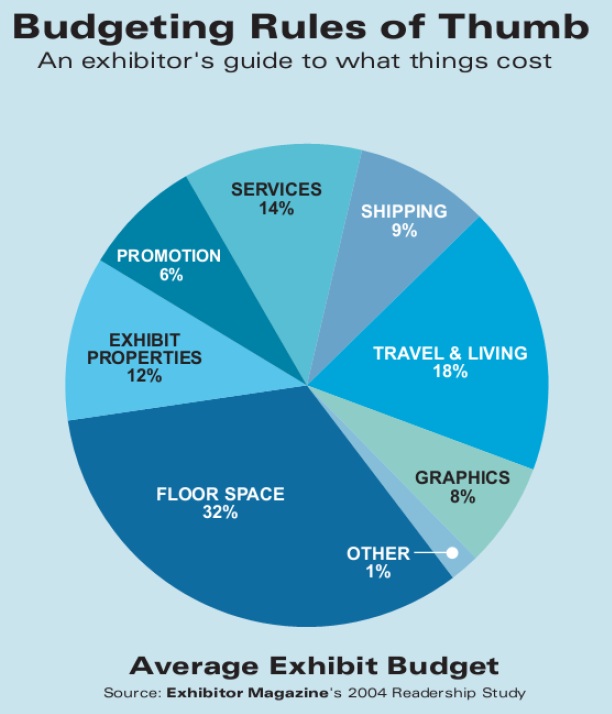 The next element of a trade show budget is exhibit design, graphics, shipping and show services. These items will all include all your exhibit design and layout needs for your booth, such as the graphics, display, shipping, labor, cleaning, power, internet and other maintenance and technological needs of the booth. Around 43% of your budget would go into all of these exhibit related items.
The final portion of a trade show budget are promotional activities, travel and other expenses. You can limit your travel expenses by booking in advance at airlines and hotels. Lastly, I always recommend an additional 5% -8% (or even 10%) as a “buffer” or emergency expense for unforeseen items or an emergency expense.
To help our clients easily plan their budgets, we’ve created a “Budgeting Worksheet” and “Budget Rules of Thumb”. Use the contact form below, to request a copy.
[contact-form][contact-field label=’Name’ type=’name’ required=’1’/][contact-field label=’Email’ type=’email’ required=’1’/][contact-field label=’Phone Number’ type=’text’ required=’1’/][contact-field label=’Comment’ type=’textarea’ required=’1’/][/contact-form]
 At trade shows, businesses get a chance to gain new leads, make new contacts and even
  It’s been 7 years since Skyline published the pre-cursor to this book, calledCreating Effective Trade Show Promotions. At the time, it was perhaps the most complete book ever made about how to boost trade show results through pre-show and at-show promotions. Yet now it’s become horribly out of date.
 The goal of this new book is to provide booth staffers — and the people who manage them — better insights, tools, and ideas to increase their trade show results.
 Welcome to The Big Time.
 The Versatile Inline Exhibit
 1.) Create a closed-loop follow-up system. Once the show closes, who’s responsible for the leads generated at your trade show? The follow-up should be a joint effort between both the sales & marketing teams. Separate leads into categories, such as A, B & C. The A leads, maybe 10% of those generated, should be the priority of sale reps. The B & C leads can be matured by the marketing team through continued communication from your company. You can tailor this system to your needs, but regardless, all information should be tracked in a CRM system.


