
Welcome to WordPress. This is your first post. Edit or delete it, then start blogging!
Author: michaelflavinnew
What’s your biggest trade show headache?
Take our short, unscientific survey and find out what your peers are experiencing too.
How to Get On the Trade Show Dance Card
 Often, companies decide to exhibit at a trade show without giving importance to the attendees. Attendees or the company’s target market, don’t come without prior research on all the companies exhibiting, especially the ones of their interest. Most trade show attendees research exhibitors before they attend. If you haven’t planned it out properly, then there’s a high likelihood that the attendees don’t put you on their dance card.
Be Sure of What You’re Selling
If you are standing at the booth clueless of what products you have and what are their benefits and uses, then it will send a red signal to the attendees visiting your booth. Make sure you booth staffers study everything prior to the show and make sure you have all the answers to an attendee’s questions about the company or its products.
An Effective Marketing Plan
Pre-show marketing plans are often the reason behind a booth getting lots of attendees. When you develop a strategic & creative marketing plan and portray the best of your company in your campaigns which will run all over social media or even ATL (above-the-line) and BTL (below-the-line) activities, you will be able to entice a lot of potential customers to your booth. It will also help impress existing customers and continue staying top of mind with them.
 Make Good Offers
If your booth is designed in a unique way and has all the attractive signage and display, you will get on the attendees’ dance card. To make your strategy work even better, you can offer something in return. What if there’s a colorful attractive display saying that ‘visit our booth and see what we have for you’ ‘what’s better than a free sample, incentive or demonstration?’
It is not an easy task to get on the trade show dance card. It takes a lot of planning & performance and only then will the result be overwhelming.
Learning Trade Show Skills From A 2-Year Old
It’s a true joy raising a child (most of the time) and I’m amazed at, not only the childhood experiences that I had forgotten, but also the lessons a parent can learn from a child.
My son is currently 2-1/2 years old and I’ve recently realized that many of his life experiences can be related to the important trade show skills a marketer & booth staffer should learn.

Ask questions to engage & learn about your prospects
Recently, my son has started asking a lot of questions:
What’s that noise?
That’s a siren from a firetruck.
What’s a firetruck
The firetruck carries the firemen to the people who need a fire put out.
What’s a fireman?
The fireman is a person who puts out fires.
Alright.
As you can see, asking questions uncovers a lot of information. For example, in a trade show setting, you might ask questions such as:
What brings you to the show?
Tell me more about (a problem or situation in their reply).
What if we were able to (insert suggestion about your product or service that solves their pain).
Uncovering information is a critical part of the booth staffing role which leads to prospect qualification and the proper follow-up method.
Smile
Humans have a range of emotions, however I’m also amazed at how quickly my son can recover from a sad moment into a smile. It’s infectious and his smile brightens any room. When you’re at a trade show, no matter how much your feet hurt, smile. It’s starts the process of engaging with strangers and makes them feel comfortable. You’ve then just made process of starting a discussion even easier.
 Never Give Up
How many times does a child fall before he or she learns to walk? Thousands probably. It took Edison 10,000+ tries before he invented the light bulb. He didn’t classify these as failures. Instead, he said “I have not failed 10,000 times. I have not failed once. I have succeeded in proving that those 10,000 ways will not work. When I have eliminated the ways that will not work, I will find the way that will work.”
If your trade show promo doesn’t work, if you’re not drawing a lot of traffic, if your booth staffers aren’t asking the right questions — don’t give up. Find the way that will work.
How Do You Get Noticed At A Trade Show?
Trade shows are a great way to attract potential customers and keep in touch with current customers. But to do this job, one must know how to effectively promote the company and set up a booth that draws all the attention. It is not easy to catch the attention of all attendees. You need to think out of the box and create an experience that stands out in the entire show.
 Here are some tips to get noticed at a trade show:
Eye-catching Displays
The most important thing is the visual appeal of your booth. When you have incorporated good lighting, bright colors, creative banners and the interior design in your booth, the attendees will automatically notice your booth among the rest of the clutter.
Offer an Incentive
If an attendee visits your booth and looks at your products and spends time listening to you, don’t let it go to waste. Ask them to schedule a follow-up meeting or next sales step, and in return offer them small gifts or incentives. For example, a give-away or voucher for a future purchase. You can also create a solid impact by offering them a place to rest, refreshments or food items.
Influence the Attendees
When an attendee visits your booth, count yourself lucky because that person took the time to see what you are selling. Don’t start off by a sales pitch. It is very unattractive and often boring for an attendee. Try to play with words, be creative, and tell an amazing story and link it back to your business. When the attendee starts to get involved, he/she is more likely to buy your product.
Why Do I Have to Pay Drayage?
When you are planning to set up a booth at a tradeshow, you’ll need to transfer your material in the venue safely. Drayage, also commonly called material handling, is an important part of setting up your booth at a tradeshow.
Did you know that drayage is a French medical term for extracting money from your wallet?
 In all seriousness though, paying drayage for freight transfer is very important. Without your material being carefully placed at the location, you cannot set up your booth. To transport such large materials and inventory, you’ll need the help of the show contractor. You will have to carefully examine and calculate the budget because drayage costs can sometimes be a shocker at the end if not handled smartly.
Drayage charges include unloading your freight at the venue, transporting the crates to your booth space and moving crates into storage after you exhibit is setup & empty labels are applied. Additionally, at the close of the show, your empty crates will be delivered back to your booth space and, once the proper paperwork is completed, the crates will again be picked up and taken to the dock for loading on your freight carrier.
Try this!!
Pack multiple cartons in a single packing to save extra material cost.
Don’t pack unnecessary stuff, it’ll only add up to your drayage costs.
What is better?
Is shipping the material directly to the event better or to an advance warehouse?
If you ship your materials directly to the venue, it might reduce your overall budget, because many contractors charge more when they have to move the material from an outer location or an advance warehouse. Though shipping directly to the venue can cause some problems, such as delayed delivery to your booth space.
While drayage can be a frustrating and expensive part of your trade show experience, it is an important service and part of every trade show. Rather than spending time and frustration complaining about it, you should plan ahead strategically to lower the amount of crates & weights to reduce your material handling expenses.
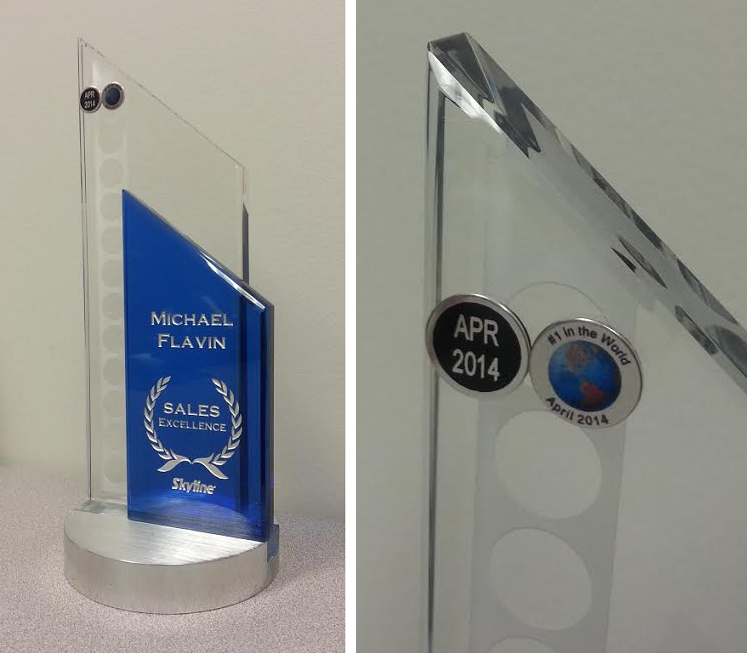
April 2014 Sales Award: Global Sales Leader
I am beyond honored to have received this recognition today, from Skyline Exhibits, as the Global Sales Leader (out of approx. 487 total) for April 2014. I’m thankful for the opportunity to help my clients increase their trade show results and eliminate headaches. And, I’m also thankful for my colleagues and all those who have helped me make this happen. Onward & upward!
10 Signs Your Company Is Not Ready for a Trade Show
If you have not planned out every detail, you might not be able to handle large-scale exposure like you’d likely to experience at a tradeshow. For many companies who are not prepared, tradeshows can become a nightmare. But, before that comes the planning phase, which will distinguish whether or not you should take part in a tradeshow. Here are 10 signs that will tell you that your company is not ready to exhibit at a tradeshow.
 1.) You aren’t clear on what you want out of a tradeshow (no clear objective).
2.) You don’t have enough budget – don’t even think of setting up a booth (no investment).
3.) You don’t have a trained sales staff which will work in the booth (lost opportunities).
4.) Haven’t informed the attendees that your company is going to be there (no pre-show marketing).
5.) You do not have enough products or supplies to display (bad design).
6.) Haven’t booked your company to be a part of the tradeshow (indecisive)
7.) Unclear about the response you are looking for (no goals).
8.) Haven’t planned the display of your booth (bad design).
9.) Haven’t outlined a follow-up plane (no post-show marketing).
10.) Haven’t developed presentations, videos, letters and emails, sales pitch, qualification forms, literature and handouts (not prepared).
Where a tradeshow can do wonders for you, at the same time it can also become very risky to participate if you haven’t planned everything accordingly. The pointers above will help you manage your company’s tradeshow; make sure you double check all of the things before making a decision about participating.
7 Things Remarkably Successful Exhibitors Do
At every trade show, there are always a select few booths where the crowds gather. Have you ever wondered what was so special about those booths? By analyzing what the most successful exhibitors do that sets them apart from the rest of the pack and earns them a massive response, there are 7 common factors that are crucial to a successful exhibit. Read on to find out these simple yet very impactful ways of exhibiting the right way at a tradeshow.
1.) A Proper Booth Staff Team
Make sure you have a dedicated team whenever you are planning on setting up a booth at a tradeshow. Often, a potential customer slips out of your hand when you are all by yourself in the booth and are unable to handle everything. This is a major turnoff and could be assumed to be the result of poor planning.
2.) Stand Out in the Crowd!
The design, colors, interior, and set up play a very important role in your success. Make your booth look attractive so that people visit you. The visual appeal of your booth is the first thing any customer will notice, so you need to do something creative with your space.

3.) Give Attendees a Warm Welcome
It is very important to communicate with your customers in a delightful manner. The attendees were probably on the venue for hours; a warm welcome can lighten them up and you never know, they might take interest in your products and engage. Offer them refreshments, and of course, ask them to sit and relax, they might have been standing for hours.
4.) Introduce Your Company
When an attendee visits your booth, make sure you give them a good introduction of your company, yourself, and your products. Keep the conversation friendly and accept questions.
5.) Don’t Bombard Attendees with a Sales Pitch
Don’t scare the attendees by immediately starting with a sales pitch without even welcoming them or making them feel comfortable. For the potential of sales to be made in the future, ask questions first, don’t start with an aggressive sales pitch.
6.) Product Packaging and Placement
You need to play with the space and your creativity. Place your products in unique shelves with attractive designs. The packaging also plays an important role because the attendees will definitely come and look at your products.
7.) Call to Action
Do not let any attendee leave without your brochure or product price list. How will they remember you and come again for an order when you haven’t given them anything to contact you? Make sure you provide everything to the attendees that can generate sales.
[contact-form][contact-field label=’Name’ type=’name’ required=’1’/][contact-field label=’Email’ type=’email’ required=’1’/][contact-field label=’Phone Number’ type=’text’ required=’1’/][contact-field label=’Comment’ type=’textarea’ required=’1’/][/contact-form]
Key Elements of a Trade Show Budget
Setting up a trade show budget can certainly include a lot of thought, research and input. You must consider the key elements of a trade show budget and how to choose a reasonable budget that enables you to perform better and reach out, and help achieving your trade show goals. Your trade show budget should be in complete accordance with the objectives of your trade show participation and therefore, it’s an important piece of the trade show planning puzzle.
To consider all kinds of expenses related to your trade show, start working on your budget at-least six months before the trade show begins (if not 9 or 12 months prior). Most of your trade show budget would go into renting the booth space alone and 32% of your entire budget, on average (according to Exhibitor Magazine’s previous studies).
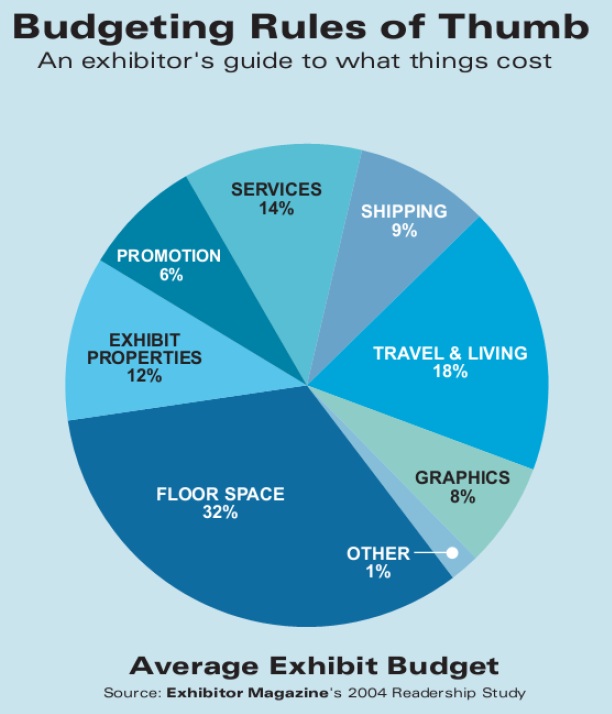 The next element of a trade show budget is exhibit design, graphics, shipping and show services. These items will all include all your exhibit design and layout needs for your booth, such as the graphics, display, shipping, labor, cleaning, power, internet and other maintenance and technological needs of the booth. Around 43% of your budget would go into all of these exhibit related items.
The final portion of a trade show budget are promotional activities, travel and other expenses. You can limit your travel expenses by booking in advance at airlines and hotels. Lastly, I always recommend an additional 5% -8% (or even 10%) as a “buffer” or emergency expense for unforeseen items or an emergency expense.
To help our clients easily plan their budgets, we’ve created a “Budgeting Worksheet” and “Budget Rules of Thumb”. Use the contact form below, to request a copy.
[contact-form][contact-field label=’Name’ type=’name’ required=’1’/][contact-field label=’Email’ type=’email’ required=’1’/][contact-field label=’Phone Number’ type=’text’ required=’1’/][contact-field label=’Comment’ type=’textarea’ required=’1’/][/contact-form]


