How Do You Get Noticed At A Trade Show?

Trade shows  are a great way to attract potential customers and keep in touch with current customers. But to do this job, one must know how to effectively promote the company and set up a booth that draws all the attention. It is not easy to catch the attention of all attendees. You need to think out of the box and create an experience that stands out in the entire show.

Here are some tips to get noticed at a trade show:

Eye-catching Displays

The most important thing is the visual appeal of your booth. When you have incorporated good lighting, bright colors, creative banners and the interior design in your booth, the attendees will automatically notice your booth among the rest of the clutter.

Offer an Incentive

If an attendee visits your booth and looks at your products and spends time listening to you, don’t let it go to waste. Ask them to schedule a follow-up meeting or next sales step, and in return offer them small gifts or incentives. For example, a give-away or voucher for a future purchase. You can also create a solid impact by offering them a place to rest, refreshments or food items.

Influence the Attendees

When an attendee visits your booth, count yourself lucky because that person took the time to see what you are selling. Don’t start off by a sales pitch. It is very unattractive and often boring for an attendee. Try to play with words, be creative, and tell an amazing story and link it back to your business. When the attendee starts to get involved, he/she is more likely to buy your product.

Why Do I Have to Pay Drayage?

When you are planning to set up a booth at a tradeshow, you’ll need to transfer your material in the venue safely. Drayage, also commonly called material handling, is an important part of setting up your booth at a tradeshow.

Did you know that drayage is a French medical term for extracting money from your wallet?

In all seriousness though, paying drayage for freight transfer is very important. Without your material being carefully placed at the location, you cannot set up your booth. To transport such large materials and inventory, you’ll need the help of the show contractor. You will have to carefully examine and calculate the budget because drayage costs can sometimes be a shocker at the end if not handled smartly.
Drayage charges include unloading your freight at the venue, transporting the crates to your booth space and moving crates into storage after you exhibit is setup & empty labels are applied. Additionally, at the close of the show, your empty crates will be delivered back to your booth space and, once the proper paperwork is completed, the crates will again be picked up and taken to the dock for loading on your freight carrier.

Try this!!

Pack multiple cartons in a single packing to save extra material cost.

Don’t pack unnecessary stuff, it’ll only add up to your drayage costs.

What is better?

Is shipping the material directly to the event better or to an advance warehouse?

If you ship your materials directly to the venue, it might reduce your overall budget, because many contractors charge more when they have to move the material from an outer location or an advance warehouse. Though shipping directly to the venue can cause some problems, such as delayed delivery to your booth space.

While drayage can be a frustrating and expensive part of your trade show experience, it is an important service and part of every trade show. Rather than spending time and frustration complaining about it, you should plan ahead strategically to lower the amount of crates & weights to reduce your material handling expenses.

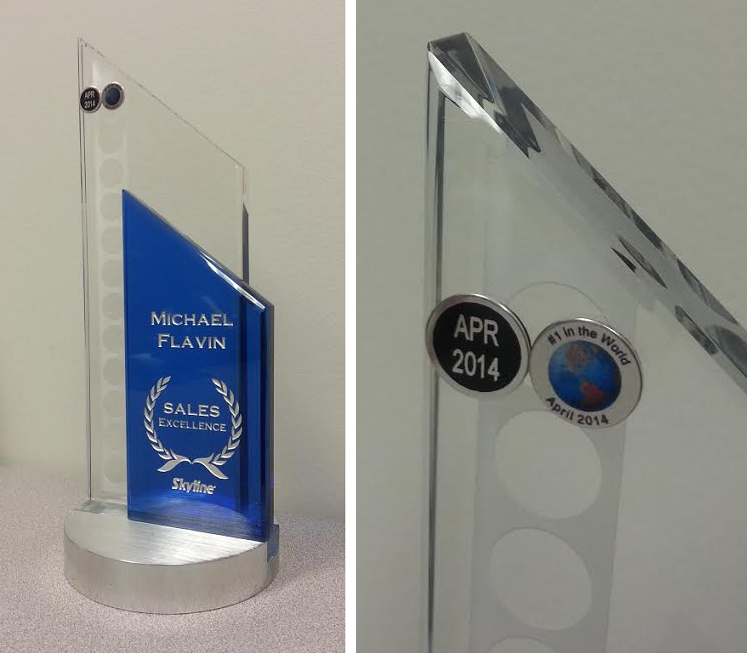
April 2014 Sales Award: Global Sales Leader

I am beyond honored to have received this recognition today, from Skyline Exhibits, as the Global Sales Leader (out of approx. 487 total) for April 2014. I’m thankful for the opportunity to help my clients increase their trade show results and eliminate headaches. And, I’m also thankful for my colleagues and all those who have helped me make this happen. Onward & upward!

April2014GlobalSalesLeader

10 Signs Your Company Is Not Ready for a Trade Show

If you have not planned out every detail, you might not be able to handle large-scale exposure like you’d likely to experience at a tradeshow. For many companies who are not prepared, tradeshows can become a nightmare. But, before that comes the planning phase, which will distinguish whether or not you should take part in a tradeshow. Here are 10 signs that will tell you that your company is not ready to exhibit at a tradeshow.

ID-100331771.) You aren’t clear on what you want out of a tradeshow (no clear objective).

2.) You don’t have enough budget – don’t even think of setting up a booth (no investment).

3.) You don’t have a trained sales staff which will work in the booth (lost opportunities).

4.) Haven’t informed the attendees that your company is going to be there (no pre-show marketing).

5.) You do not have enough products or supplies to display (bad design).

6.) Haven’t booked your company to be a part of the tradeshow (indecisive)

7.) Unclear about the response you are looking for (no goals).

8.) Haven’t planned the display of your booth (bad design).

9.) Haven’t outlined a follow-up plane (no post-show marketing).

10.) Haven’t developed presentations, videos, letters and emails, sales pitch, qualification forms, literature and handouts (not prepared).

Where a tradeshow can do wonders for you, at the same time it can also become very risky to participate if you haven’t planned everything accordingly. The pointers above will help you manage your company’s tradeshow; make sure you double check all of the things before making a decision about participating.


7 Things Remarkably Successful Exhibitors Do

At every trade show, there are always a select few booths where the crowds gather. Have you ever wondered what was so special about those booths? By analyzing what the most successful exhibitors do that sets them apart from the rest of the pack and earns them a massive response, there are 7 common factors that are crucial to a successful exhibit. Read on to find out these simple yet very impactful ways of exhibiting the right way at a tradeshow.

1.) A Proper Booth Staff Team

Make sure you have a dedicated team whenever you are planning on setting up a booth at a tradeshow. Often, a potential customer slips out of your hand when you are all by yourself in the booth and are unable to handle everything. This is a major turnoff and could be assumed to be the result of poor planning.

2.) Stand Out in the Crowd!

The design, colors, interior, and set up play a very important role in your success. Make your booth look attractive so that people visit you. The visual appeal of your booth is the first thing any customer will notice, so you need to do something creative with your space.

3.) Give Attendees a Warm Welcome

It is very important to communicate with your customers in a delightful manner. The attendees were probably on the venue for hours; a warm welcome can lighten them up and you never know, they might take interest in your products and engage. Offer them refreshments, and of course, ask them to sit and relax, they might have been standing for hours.

4.) Introduce Your Company

When an attendee visits your booth, make sure you give them a good introduction of your company, yourself, and your products. Keep the conversation friendly and accept questions.

5.) Don’t Bombard Attendees with a Sales Pitch

Don’t scare the attendees by immediately starting with a sales pitch without even welcoming them or making them feel comfortable. For the potential of sales to be made in the future, ask questions first, don’t start with an aggressive sales pitch.

6.) Product Packaging and Placement

You need to play with the space and your creativity. Place your products in unique shelves with attractive designs. The packaging also plays an important role because the attendees will definitely come and look at your products.

7.) Call to Action

Do not let any attendee leave without your brochure or product price list. How will they remember you and come again for an order when you haven’t given them anything to contact you? Make sure you provide everything to the attendees that can generate sales.


[contact-form][contact-field label=’Name’ type=’name’ required=’1’/][contact-field label=’Email’ type=’email’ required=’1’/][contact-field label=’Phone Number’ type=’text’ required=’1’/][contact-field label=’Comment’ type=’textarea’ required=’1’/][/contact-form]

Key Elements of a Trade Show Budget

Setting up a trade show budget can certainly include a lot of thought, research and input. You must consider the key elements of a trade show budget and how to choose a reasonable budget that enables you to perform better and reach out, and help achieving your trade show goals. Your trade show budget should be in complete accordance with the objectives of your trade show participation and therefore, it’s an important piece of the trade show planning puzzle.

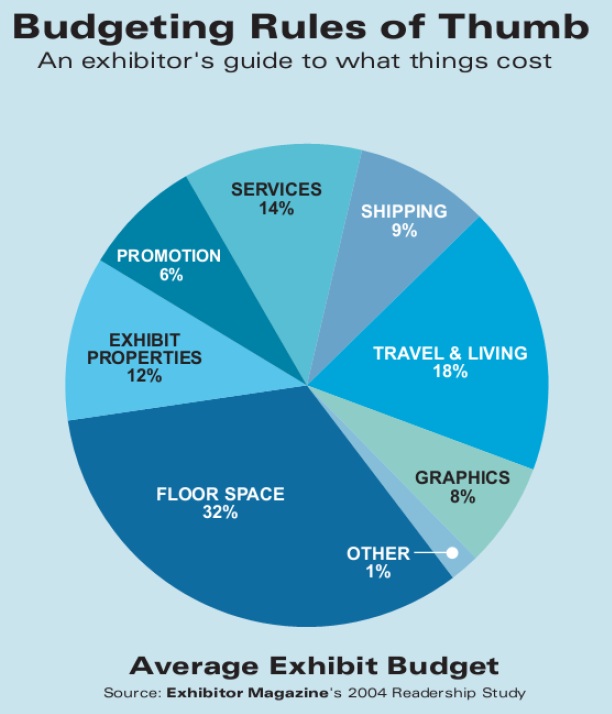
To consider all kinds of expenses related to your trade show, start working on your budget at-least six months before the trade show begins (if not 9 or 12 months prior). Most of your trade show budget would go into renting the booth space alone and 32% of your entire budget, on average (according to Exhibitor Magazine’s previous studies).

BudgetingRulesOfThumbThe next element of a trade show budget is exhibit design, graphics, shipping and show services. These items will all include all your exhibit design and layout needs for your booth, such as the graphics, display, shipping, labor, cleaning, power, internet and other maintenance and technological needs of the booth. Around 43% of your budget would go into all of these exhibit related items.

The final portion of a trade show budget are promotional activities, travel and other expenses. You can limit your travel expenses by booking in advance at airlines and hotels. Lastly, I always recommend an additional 5% -8% (or even 10%) as a “buffer” or emergency expense for unforeseen items or an emergency expense.

To help our clients easily plan their budgets, we’ve created a “Budgeting Worksheet” and “Budget Rules of Thumb”. Use the contact form below, to request a copy.

[contact-form][contact-field label=’Name’ type=’name’ required=’1’/][contact-field label=’Email’ type=’email’ required=’1’/][contact-field label=’Phone Number’ type=’text’ required=’1’/][contact-field label=’Comment’ type=’textarea’ required=’1’/][/contact-form]

Using a CRM to Follow-Up on Trade Show Leads

CRM stands for Customer Relationship Management, and the term is self-explanatory because all companies & organizations strive to meet customer needs and expectations. CRMs have been in use by organizations for years, but the actual term came into use during the advent of technology in business. Implementing a CRM system is the best way an organization has a chance at succeeding in this competitive era.

At trade shows, businesses get a chance to gain new leads, make new contacts and even sell their products & services to actual buyers. 86% of the people attending a trade show have the authority to purchase, according to a survey from CEIR.org. Additionally, they have found that 79% of trade show leads are never followed-up afterwards. This means that if you pitch yourself in the right way using a CRM system following a trade show, there is a high possibility that you will generate even more leads and sales.

Using the technology of a CRM system, to follow-up on leads can help you attain your long-term goals. Trade show leads can help you retain profitable customers & also find new customers. To follow-up on these leads, you need to incorporate a CRM system. Some CRM applications scan business cards and input contact information right from the trade show. This gives a company the chance to establish adequate customer retention strategies and communicate easily with new contacts. A cloud-based CRM system is especially helpful because it allows the entire team/company to connect on a single platform, enabling efficient exchange of company and customer data, from anywhere in the world, even at a trade show.

CRM systems convert your leads into sales through effective marketing plans. Pre or post marketing for a trade show can be easily planned by your CRM software using Campaign features. With just a few clicks, you are able to create effective marketing, easily communicate with prospects and stay top of mind to continue nurturing more opportunities.

If you are still using traditional means to follow-up on trade show leads, consider implementing a CRM system to help organize information, quickly follow-up with prospects and increase the potential of more opportunities for your business.


[contact-form][contact-field label=’Name’ type=’name’ required=’1’/][contact-field label=’Email’ type=’email’ required=’1’/][contact-field label=’Phone Number’ type=’text’ required=’1’/][contact-field label=’How Can I help you?’ type=’textarea’ required=’1’/][/contact-form]

Simple Steps For Designing A Modern Trade Show Exhibit

A successful, modern trade show exhibit can take your business and service’s success to a new height. Your trade show exhibit should be a complete representation of your company & your business. The target audience should be able to quickly gather thorough information about what you offer and how you differ from the rest of the competitors.


Each year, I’m often asked, “What are the latest trade show exhibit design trends?”


Any successful, creative and engaging trade show design starts with the trade show design creative team. To get your team started in the right direction, provide a creative brief about who you are, who your target audience is and what message you want to convey and how you want to stand out.


Securing a booth at a trade exhibition is a large investment. Designing the booth requires input from the creative design team who sets a vision for your brand and helps you get your message across to the target audience within available finances.


A trade show booth should not be all about flashing lights, loud music and pushy booth staffers. If you want to attract potential customers go basic; exhibitors are now moving to more relaxed and peaceful settings where the customers can easily interact with the sales team and get questions to their answers.


Recently, I’ve seen soft exhibit designs, with basic colors and smooth lines that only highlight the product or service in focus. When thinking about the exhibit structure and your graphics, look at what other exhibitors do at your trade shows. Consider the layouts at retail environments and office spaces. By looking at multiple resources, you’ll help your creative team by supplying a list of “like and dislikes” in these environments that relate to your brand & objectives.


In today’s digital age, the more interactive you are with your target audience, the better you can send your message across, design your trade booth with a display of touch screen monitors, tablets, that are loaded with videos and animations describing your product or services.


Finally, remember that a successful and modern trade show exhibit is not solely focused on the booth. If you’re not training booth staffers well and implementing creative marketing objectives, you’ll end up with a beautiful, but empty booth space.
[contact-form][contact-field label=’Name’ type=’name’ required=’1’/][contact-field label=’Email’ type=’email’ required=’1’/][contact-field label=’Phone Number’ type=’text’/][contact-field label=’Comment’ type=’textarea’ required=’1’/][/contact-form]